EU Calls Emergency Meeting Over Ceuta Migrant Surge, Border Tensions
The EU will hold emergency talks after 22 member states demanded coordinated action following a massive migrant influx into Ceuta.
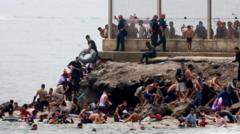
The European Union is convening an emergency meeting on Tuesday to address the escalating migration crisis in the Spanish enclave of Ceuta. The urgent talks come after 22 member states issued a joint letter calling for coordinated action and the reinforcement of the EU's external borders. This collective call follows a significant surge in migrant arrivals, with approximately 60,000 individuals entering Ceuta from Morocco.
The situation has created diplomatic friction between Spain and other EU members. Spain has condemned what it termed "selfish, polarising and unlawful" reactions from some nations, particularly after Italy announced the suspension of the EU's border-free Schengen arrangement with Spain, a move also supported by Finland and Denmark. Officials report that nearly all migrants who arrived in Ceuta on July 30 have since returned to Morocco, though the surge in crossings has been linked to at least 67 deaths.
The joint letter from the 22 member states expresses concern about "hybrid threats" that could foster a perception of easy illegal entry into the EU. They argue that such a perception could encourage further attempts, erode confidence in common migration policies, and have widespread repercussions across all member states. Signatories include leaders from the Netherlands, Finland, and Belgium, and the letter is addressed to EU President Antonio Costa, European Commission President Ursula von der Leyen, and Irish Taoiseach Michael Martin, representing the current Council of the European Union presidency.
Spanish Prime Minister Pedro Sánchez conveyed his "serious concerns" about certain European governments in a separate letter to Ursula von der Leyen. He asserted that Spain had swiftly re-established border control and prevented onward movement to continental Europe within 48 hours. Sánchez stated that while most EU governments offered solidarity, others attacked Spain based on prejudice, misinformation, ignorance, or political motives, highlighting that Ceuta is not part of the Schengen area.
Earlier, on Friday, Sánchez accused migrant traffickers of exploiting a recent Spanish Supreme Court ruling that limited the government's ability to deport sea arrivals immediately. Spain's Interior Minister, Fernando Grande-Marlaska, announced on Saturday that the situation in Ceuta had largely returned to normal, with businesses reopening. He also indicated that the country was developing an inflatable barrier system to deter illegal sea crossings.
The crisis has brought renewed attention to the Schengen Area, an agreement that has eliminated border checks for over 450 million people across 29 European countries. Italy's suspension of its Schengen agreement with Spain for one month, along with Finland, France, and Portugal considering border checks, underscores the strain on the open-border system.
Danish Prime Minister Mette Frederiksen has urged the EU to explore all available options to manage the situation. The influx of migrants has presented Spain with a significant diplomatic challenge, prompting calls for a unified EU approach to border management and migration policy.
Questions remain about the long-term implications for the Schengen Area and the EU's broader migration strategy. The emergency meeting is expected to focus on developing a coordinated response to prevent future crises and strengthen external border security.
This article was written by AI based on publicly available news reporting. Original reporting by the linked source.