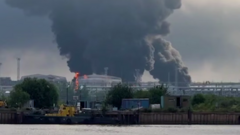
Ukraine Strikes Major St. Petersburg Oil Terminal, Naval Base
Ukraine launched drone attacks overnight, hitting a major oil terminal and naval base in Russia's St. Petersburg, President Zelensky announced.
Ukraine conducted a significant overnight drone assault on Russia's second-largest city, St. Petersburg, striking a major oil terminal and a key naval base, President Volodymyr Zelensky announced early Saturday. The attack targeted critical infrastructure that Ukraine claims generates revenue essential for Russia's ongoing war effort.
St. Petersburg Governor Aleksandr Beglov confirmed the city experienced a massive drone attack, acknowledging that the oil terminal was hit. He reported no casualties resulting from the strikes. This incident marks a notable escalation in Ukraine's strategy to disrupt Russia's energy sector, with Kyiv asserting that nearly 43% of Russia's oil refining capacity has been disabled by its strikes. This figure has not been independently verified.
Ukraine's military described the targeted oil terminal as one of Russia's largest, with an annual production capacity of 12.5 million tonnes of petroleum products. The military also stated that a significant Russian naval base in Kronstadt, home to the Russian Baltic Fleet, was struck. A video released by President Zelensky showed a drone approaching a target followed by a large plume of black smoke. The BBC later verified the strike on the oil terminal.
Governor Beglov stated that 72 Ukrainian drones were intercepted and shot down over St. Petersburg and the surrounding Leningrad region. He advised residents to remain indoors until the drone threat subsided and warned of potential disruptions to mobile internet services. Over five million people reside in the St. Petersburg metropolitan area.
Ukraine views Russian oil and gas facilities as legitimate targets, arguing that Moscow heavily relies on fossil fuel exports to finance its military operations. This perspective comes after Russian President Vladimir Putin recently acknowledged fuel shortages, attributing them to Ukrainian attacks. In response, Putin signed a bill aimed at increasing domestic fuel market supplies.
President Zelensky noted that the targeted locations in St. Petersburg and the Leningrad region are approximately 850 kilometers (528 miles) from Ukraine's border, highlighting the extended reach of Ukrainian drone capabilities. The full extent of the damage to the oil terminal and naval base remains unclear.
In a separate development on Saturday, Ukraine's military spokesperson, Major Andriy Kovalyov, denied Russian claims that the eastern Ukrainian town of Kostyantynivka was under full Russian control. He stated that the town remains under Ukrainian defense forces' control, while acknowledging isolated instances of small Russian infantry groups infiltrating Ukrainian lines, which were subsequently being neutralized.
President Putin had previously claimed Russian forces had secured control of Kostyantynivka in June, a claim for which he provided no evidence. Major Kovalyov’s comments directly refuted this assertion, emphasizing ongoing Ukrainian military operations in the region.
This article was written by AI based on publicly available news reporting. Original reporting by the linked source.