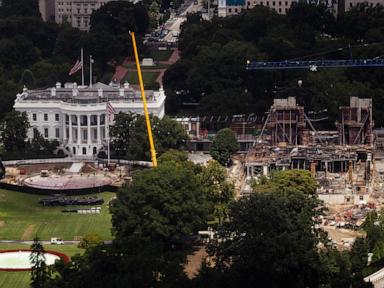
Trump's $400M ballroom construction blocked by appeals court
A federal appeals court halted President Trump's $400 million White House ballroom, rejecting his national security claims.
A federal appeals court on Friday blocked the construction of President Donald Trump's proposed $400 million ballroom, rejecting the administration's national security justifications for the project. The ruling marks another significant legal obstacle for the ambitious plan, which has faced challenges since its proposal in July 2025.
President Trump has consistently argued that the extensive project, which he claims is vital for the nation's security, must be built. Following the court's decision, he posted on social media that the entire complex is being built for the protection of the country and vowed to appeal the case to the U.S. Supreme Court. He described the ruling as a "National Security Threat at the highest level" and a "National Disgrace," particularly as much of the work has already been completed and paid for.
The judges on the federal appeals court, Patricia Millett and Bradley Garcia, stated that the president does not possess the unilateral authority to authorize such substantial alterations to the White House without congressional approval. They further asserted that the executive branch cannot operate with "utter lawlessness," destroying national landmarks and disregarding individual interests, without judicial oversight.
In a dissenting opinion, District of Appeals Judge Neomi Rao criticized the majority's decision, arguing that the government should not be impeded from securing the president's home and office based on architectural approvals from a lower court. Previously, a district court judge had modified an injunction in April to permit security-related work to continue while halting ballroom construction.
President Trump has publicly detailed numerous features he intends to incorporate into the 90,000-square-foot structure. These include bomb shelters, advanced medical facilities, top-secret military installations, and missile-resistant structural components. He also mentioned drone-proof ceilings and roofs, military-grade ventilation, and ballistic-proof glass. AI-generated images shared on social media depicted armed guards, military vehicles, and drones on the ballroom's roof, which Trump described as a "vital" component for national security and military operations.
The court's ruling will not take effect for two weeks, allowing time for a potential appeal. Underground construction related to security features, such as the military facilities and bomb shelters, is permitted to proceed.
The administration's push for the ballroom has been met with significant legal scrutiny, with opponents questioning the necessity and the process of its approval. The significant cost of the project has also drawn attention and debate.
This legal battle highlights ongoing tensions between the executive branch's asserted national security needs and the checks and balances designed to oversee major federal projects, especially those impacting historic national landmarks. The Supreme Court's potential involvement could set a significant precedent.
This article was written by AI based on publicly available news reporting. Original reporting by the linked source.