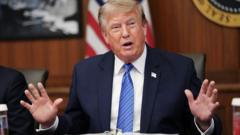
Trump Denies US Munitions Shortage, Vows Jail for "Leakers"
President Trump refutes claims of US weapons shortages amidst ongoing conflict, vowing harsh penalties for information leakers.
President Donald Trump on Thursday denied reports of a US munitions shortage, asserting in a social media post that the nation possesses "massive amounts" of weaponry and is actively manufacturing more. He also vowed to pursue "long term jail sentences" for individuals suspected of leaking what he termed "treasonous statements" regarding the military's arsenal.
The president's statements come as the US faces mounting questions about its military supplies, with the conflict now in its sixth month and a peace deal with Iran remaining elusive. Reports from US news outlets, citing unnamed sources, suggested that the US has depleted a significant portion of its long-range precision missile stockpiles. The Washington Post also reported that Trump had confronted Defense Secretary Pete Hegseth over a potential weapons shortfall.
Trump directly addressed the Washington Post's reporting, calling it "fake 'reporting'" and "treasonous." He reiterated his confidence in Defense Secretary Pete Hegseth, stating he was "extremely happy" with his performance. Precise details regarding US missile stocks are classified, but reports from organizations like the Center for Strategic and International Studies (CSIS) have provided estimations based on publicly available data.
CSIS estimated that by the end of July, the US had between 759 and 827 Patriot missiles remaining, representing about a third of the pre-conflict total. The think tank also suggested that approximately 60% of Terminal High Altitude Area Defense (THAAD) missiles, designed for intercepting strikes, have been expended. These figures highlight concerns about the strain on US weapon supplies, particularly given the high expenditure during operations like "Operation Epic Fury" and subsequent retaliatory actions.
Iran, in response to reports of shrinking US supplies, stated that its domestically produced weapons provide the capability to counter any threat. Defense Minister Majid Ibn-e-Reza posted on X that Iran's armed forces, supported by the nation's defense industry, are "fully equipped to respond to any threat." He further asserted that those seeking security through imported systems would find Iran's indigenous technology superior in the region.
Beyond the immediate conflict, the US faces increased global demand for its weapons. Significant military aid has been provided to Ukraine, which could further strain existing stockpiles. This broader demand, coupled with the ongoing conflict, intensifies scrutiny on the readiness and capacity of the US military industrial complex.
Since becoming secretary, Pete Hegseth has reportedly implemented stricter controls on information dissemination from the Pentagon, aiming to limit what reporters can gather. This move, alongside the current controversy, underscores the sensitive nature of military supply information and the administration's efforts to manage public perception and control the narrative.
The situation raises questions about the long-term implications for US defense readiness, its ability to project power globally, and the effectiveness of its industrial base in sustaining prolonged high-intensity conflicts. The administration's strong denial and aggressive stance against alleged "leakers" suggest a determination to counter negative reporting and maintain an image of robust military strength.
This article was written by AI based on publicly available news reporting. Original reporting by the linked source.