EU Seeks Stronger Borders After 70,000 Migrants Cross Into Ceuta
EU calls for united action on border security after tens of thousands of migrants crossed into Spain's Ceuta.
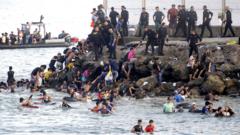
European Commission President Ursula von der Leyen has urged a united European response to strengthen external borders following a significant influx of migrants into Spain's North African exclave of Ceuta. The unprecedented crossing saw an estimated 69,500 migrants return to Morocco, with official figures reporting 72 deaths on the Spanish side and 11 on the Moroccan side.
This event has placed a strain on relations between EU member states, prompting emergency talks among EU interior ministers. Von der Leyen, in a letter to Spanish Prime Minister Pedro Sánchez, acknowledged his swift handling of the crisis but emphasized the need for enhanced border security at critical points. The incident has led some EU nations, including Italy, Finland, and Denmark, to consider or temporarily suspend aspects of the Schengen agreement, which normally allows for free movement across borders.
Von der Leyen highlighted that the protection of external borders is a shared European responsibility. She called for vigilant monitoring and the potential use of physical barriers where necessary. The upcoming video conference aims to draw lessons from the Ceuta episode and address the challenges of illegal immigration with a common, united approach, emphasizing solidarity.
Key areas for reinforced action include preventing irregular migration through cooperation with partner states, strengthening external borders, implementing early warning systems, dismantling smuggling networks, and reinforcing return policies. Spain's Prime Minister Pedro Sánchez has attributed the surge to migrant traffickers exploiting a recent court decision that limited the government's immediate deportation powers for those arriving by sea.
The situation in Ceuta has underscored the complex geopolitical and humanitarian challenges at Europe's external frontiers. While many EU nations offered support, some have been criticized by Spain for their reactions, which were described as driven by prejudice, misinformation, ignorance, or political interests.
Spain's Interior Minister, Fernando Grande-Marlaska, stated that the situation was nearing normalcy and that the country was developing measures, such as an inflatable barrier, to deter future attempts at illegal migration via water.
The Schengen agreement, which eliminates internal border checks for over 450 million people across 29 countries, has come under scrutiny as a result of the crisis. The temporary suspensions and calls for suspending Spain's membership highlight the tensions between maintaining open borders and ensuring national security.
This incident serves as a critical test for the EU's ability to forge a cohesive policy on migration and border management, particularly in response to sudden and large-scale movements of people across its external boundaries.
This article was written by AI based on publicly available news reporting. Original reporting by the linked source.