Canadian Wildfire Smoke Blankets 100 Million Americans Across 10+ States
Dangerous smoke from nearly 900 Canadian wildfires has spread across the U.S., causing unhealthy air quality in over a dozen states.
Hundreds of wildfires burning in Canada have sent a plume of dense, toxic smoke south, impacting the air quality for over 100 million Americans across more than a dozen states. Air quality alerts were in effect Friday, stretching from the Midwest and Great Lakes regions eastward to the Northeast and Mid-Atlantic.
This widespread smoke poses significant health risks, as it contains fine particulate matter that can be inhaled deep into the lungs. Major metropolitan areas, including Chicago, Detroit, Washington D.C., Philadelphia, and New York City, are experiencing unhealthy to hazardous air conditions, leading to public health warnings and disruptions to outdoor activities.
Officials in Philadelphia issued a Code Purple Air Quality Emergency Day, warning that all individuals may experience negative health effects, with sensitive groups facing more severe consequences. In Milwaukee, the Brewers baseball team offered ticket exchanges for Friday night's game due to the hazardous air. Similarly, the Cleveland Guardians postponed their home game against the Pittsburgh Pirates due to the poor air quality.
The smoke is expected to persist in some areas while improving in others. While rain in the Ohio Valley, Northeast, and Mid-Atlantic on Saturday may bring relief, parts of the Midwest and Great Lakes are anticipated to continue experiencing dangerous air quality. The situation remains dynamic due to the nearly 900 wildfires currently burning in Canada, over 200 of which are classified as out of control.
Adding to the complexity, weather patterns in Canada, such as heavy rain near the Minnesota border, could bring strong winds and lightning. While rain might aid some firefighting efforts, these conditions also have the potential to spark new fires and increase erratic fire behavior. Similar weather is forecast for Ontario, with passing showers and thunderstorms that are unlikely to extinguish the larger blazes and could worsen conditions.
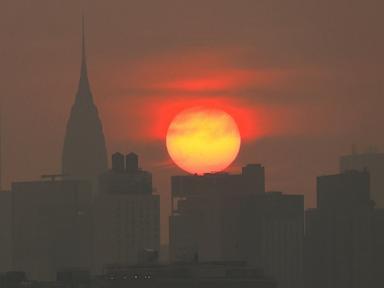
The visual impact of the smoke is stark, with city skylines obscured and the sun appearing dim. Images from New York City showed the sun rising behind buildings through a thick haze, while in Washington D.C., the smoke muted the iconic monuments. The smoke's trajectory suggests it could also affect the New York City area on Sunday, potentially impacting the FIFA World Cup Final.
The sheer scale of the Canadian wildfires, with hundreds actively burning, underscores the growing challenge of managing large-scale blazes influenced by climate conditions. The ongoing spread of smoke across such a vast geographical area highlights the transboundary nature of environmental issues and the interconnectedness of air quality.
Authorities continue to monitor the situation closely, advising residents in affected areas to limit outdoor exposure, especially those with respiratory conditions, the elderly, and children. The long-term implications for public health and the environment remain a concern as the fire season progresses.
This article was written by AI based on publicly available news reporting. Original reporting by the linked source.