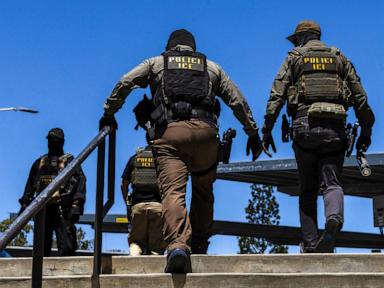
Woman Claims ICE Agent Pointed Gun, Denies Trying to Run Over Agents
Virginia woman Carolina Molina alleges an ICE agent pointed a gun at her and falsely accused her of trying to run over officers.
A Virginia woman has come forward alleging that a federal immigration agent pointed a firearm at her head and fabricated claims that she attempted to run over officers during a recent encounter in Falls Church. Carolina Molina, 36, recounted the incident during a press conference organized by immigrant advocacy groups.
Molina stated that she was visiting local law offices to network and distribute business cards when she observed unmarked vehicles and federal agents conducting arrests. While driving past one Immigration and Customs Enforcement (ICE) agent, she admitted to shouting an insult out of her window, asserting her First Amendment rights.
According to Molina, an ICE agent then blocked her vehicle, exited his car, and pointed a gun at her while questioning her actions. Molina maintained that she was attempting to leave the area and was trying to distribute business cards. She stated that the situation escalated when she began recording the interaction with her cell phone.
"That is when it feels like the situation changed," Molina said, suggesting the agent then began to accuse her of attempting to run them over, a claim she vehemently denies. She described being "shocked" when the agent drew his weapon, questioning the agent's actions in disbelief.
In response, the Department of Homeland Security (DHS) issued a statement claiming Molina "began to drive her car in circles around our ICE officers and then attempted to harm officers by weaponizing her vehicle against them—all in an attempt to help illegal aliens get away." The DHS statement added that ICE officers "conducted a vehicle stop of the driver" out of fear for their safety and indicated that Molina could face criminal prosecution.
The incident highlights ongoing tensions and differing accounts in encounters between federal immigration enforcement and the public. Advocacy groups often raise concerns about the tactics used by ICE agents, while the agency maintains that its officers must protect themselves and carry out their duties.
Molina's account, if substantiated, raises questions about the use of force and the accuracy of reporting during such interactions. The DHS statement directly contradicts her narrative, presenting a clear divergence in the understanding of the events that transpired.
Further details regarding any potential criminal prosecution or official investigation into the incident have not yet been released. The conflicting accounts leave unresolved questions about the exact sequence of events and the justification for the agent's actions.
This article was written by AI based on publicly available news reporting. Original reporting by the linked source.