Three household methods offer safe solar eclipse viewing without special glasses.
Without eclipse glasses, household items like colanders, card, and cardboard boxes can be used for safe solar eclipse viewing.
As eclipse glasses become scarce, with many online orders unable to arrive in time and shops depleted of stock, alternative safe viewing methods using common household items are being highlighted for the upcoming solar spectacle.
Experts strongly advise against looking directly at the Sun without specialized eyewear, and caution that regular sunglasses or dark goggles are insufficient for protection, potentially causing serious eye damage due to inadequate UV filtering, according to The Royal Astronomical Society.
The UK will experience a partial solar eclipse, a significant event for the country since 1999, while parts of Spain, Greenland, and Iceland will witness a total eclipse. The urgency to find safe viewing solutions arises from the limited availability of certified eclipse glasses.
One recommended method is a pinhole projector, which can be constructed using a piece of card and a pen. By making a small hole in the card and holding it at a distance from a blank piece of paper, away from the Sun, an inverted image of the Sun's shadow can be projected onto the paper, allowing for observation of the eclipse.
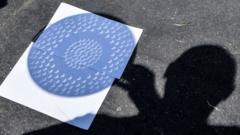
Another simple technique involves using a colander. An eye specialist suggests holding a colander up to the Sun and looking away from it, which can project multiple miniature images of the eclipse onto a surface, offering a "kaleidoscope of images" without direct solar exposure.
For a clearer image, a pinhole viewer can be made from a cardboard box, such as an empty cereal box. This method involves creating a small hole covered with foil and a pin in one end of the box, and a viewing screen inside. When positioned correctly with the back to the Sun, it allows for a focused projection of the eclipse onto the screen.
These methods provide accessible ways for the public to witness the astronomical event safely, circumventing the widespread shortage of specialized eclipse viewing glasses. The emphasis remains on indirect viewing to prevent any harm to eyesight.
Further details on how and when to see the eclipse, along with warnings from individuals who have suffered eye damage from improper viewing in the past, are being widely circulated to underscore the importance of safe observation practices during this rare celestial event.
This article was written by AI based on publicly available news reporting. Original reporting by the linked source.