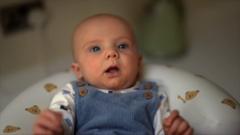
Mother Undergoes Pioneering Surgery in US to Fix Unborn Baby's Birth Defect
A British mother received groundbreaking womb surgery in the US to correct her unborn son's complex gastroschisis, making him the third baby globally to benefit from the trial.
Doctors have successfully performed a groundbreaking surgery on an unborn baby to correct a severe birth defect while he was still inside his mother's womb. The pioneering procedure took place in the United States on Maisie Savage, who was 26 weeks pregnant at the time.
Baby Theo, now five months old and in good health, was diagnosed with gastroschisis, a condition where the abdominal wall does not develop properly, causing the intestines to grow outside the body. This defect affects approximately one in 3,000 babies born in the UK annually.
During the procedure, surgeons partially exposed Maisie's womb and used keyhole surgery to gently reposition Theo's organs back into his abdomen. This marks a significant advancement in fetal surgery, offering hope for more complex cases where traditional post-birth treatment can be lengthy and carry a high mortality risk.
The success of this operation places Theo as the third baby worldwide to undergo this novel treatment as part of a clinical trial. His parents, Maisie Savage, 29, and Josh French, 36, both teachers from London, expressed immense relief and joy over the outcome.
Initially, the couple was unaware of any issues during their pregnancy. "Going towards a 20-week scan, we were purely just excited to have an image of our baby," Josh French recounted. The diagnosis of gastroschisis came as a shock, described by French as "incredibly scary."
Specialist doctors at London's Great Ormond Street Hospital (GOSH) had prepared the parents for the challenges of caring for a baby with the condition. However, when Theo was found to have the more severe "complex gastroschisis," they were referred to Texas Children's Hospital in Houston for consideration in a clinical trial.
The trial is led by Dr. Michael Belfort, who has prior experience pioneering similar in-womb procedures for conditions like spina bifida. Before the surgery in Texas, Maisie traveled to Leuven Hospital in Belgium for a procedure to relax Theo's abdominal muscles, facilitating the repair.
Theo was carried to term following the surgery and born in Texas. While the exact long-term prognosis for complex gastroschisis can involve extended intensive care, multiple surgeries, and potential intestinal transplants, Theo's successful in-utero repair signifies a major step forward in fetal medicine.
This article was written by AI based on publicly available news reporting. Original reporting by the linked source.