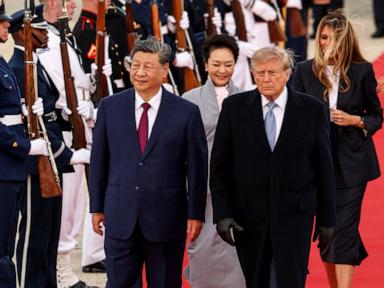
Trump Welcomes Xi Jinping with Red Carpet Amid High-Stakes Talks
President Trump hosted China's Xi Jinping with a formal arrival ceremony, as a trade truce was extended to January.
President Donald Trump and First Lady Melania Trump extended a personal welcome to Chinese President Xi Jinping and his wife, Madame Peng Liyuan, on Wednesday evening at Joint Base Andrews, Maryland. The arrival marked the beginning of a significant three-day visit where the leaders are scheduled to address a range of critical issues, including artificial intelligence safety, Taiwan, trade, the ongoing war in Iran, and the sourcing of critical minerals.
The arrival ceremony featured traditional military honors, including the U.S. Air Force band and the firing of cannons, as the couples walked down a red carpet lined with U.S. service members. Both anthems were played, with President Trump saluting during "The Star-Spangled Banner." Two B1 bombers flew overhead as a show of military power. Neither President Trump nor President Xi made public remarks upon arrival.
Following the welcoming, Treasury Secretary Scott Bessent announced that the United States and China have agreed to extend their trade truce, originally set to expire on November 10, until January 10. This extension provides additional time for discussions on economic matters between the two global powers.
The visit occurs against a backdrop of considerable international tension, with ongoing discussions expected to address the war in Iran and the complex situation surrounding Taiwan. The outcomes of these discussions could have significant implications for global stability and economic relations.
Speaking to reporters later, President Trump indicated that the war in Iran would be a topic of discussion during President Xi's visit. When asked about addressing Iran, Trump stated, "We'll see. We'll see. I'll be talking about that and many other subjects. We'll see, but it's all coming along well, including that." The president expressed optimism about the progress of discussions, suggesting a willingness to engage on multiple fronts.
Secretary Bessent, in comments to Fox News, confirmed the extension of the "Busan Agreement," referring to the economic detente between the two nations. He explained the extension is "to give us more time to see what we can do on the economic front." When questioned about whether China might be seeking a more substantial deal given the extended timeline, Bessent stated he was unsure if that was possible.
The high-level meeting between the leaders of the world's two largest economies is closely watched by international observers. The topics on the agenda, from geopolitical flashpoints like Taiwan and Iran to critical economic and technological issues, underscore the complex and multifaceted relationship between the United States and China.
Further discussions are expected to delve into the specifics of trade relations and the broader implications of artificial intelligence, a rapidly evolving field with significant global ramifications. The approach taken by both leaders in these sensitive negotiations will likely shape future international policy and cooperation.
This article was written by AI based on publicly available news reporting. Original reporting by the linked source.