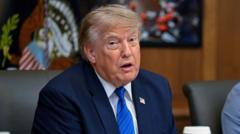
Trump Cancels Iran Strikes, Cites 'Rapid' Deal
President Trump announced cancelled strikes on Iran, pending a swift deal, after reports of planned intense attacks emerged.
President Donald Trump announced on Saturday that he has cancelled planned strikes against Iran, contingent upon a deal being reached "rapidly" with the country. The US president stated on the social media platform Truth Social that Iran and other Middle Eastern nations had requested a pause on any attack, as the parameters for a deal had reportedly been agreed upon.
These comments follow reports suggesting that the United States and Israel were contemplating new and severe strikes against Iran. This marks a recurring pattern where Trump issues strong warnings, only to later emphasize that diplomatic efforts are being prioritized. However, Iran's semi-official Mehr news agency has denied Tehran's involvement in requesting a halt to military action, characterizing Trump's statements as "nothing but a new lie."
Majid Ibn al-Reza, Iran's acting Defence Minister, stated that Tehran regards all threats from adversaries as real and credible, regardless of whether they are part of psychological warfare. He added that Iran would "neither be caught off guard nor remain passive."
The heightened rhetoric emerged after U.S. media outlets reported that the U.S. and Israel were planning what could be one of the most aggressive bombing campaigns to date, targeting energy infrastructure in Iran. Sources indicated to CBS News, the BBC's U.S. partner, that this plan was discussed during a cabinet meeting on Friday.
In his social media post, Trump described the U.S. as "locked and loaded" and prepared to act against Iran with "levels of Military Terror, Strength, and Power not seen since World War II." He framed the cancellation of the attack as being for the "future benefit of the world and, likewise, the survival of a successful and prosperous Iran."
This situation echoes a similar warning on April 7th, when Trump threatened to "destroy civilian infrastructure and power plants" if Iran refused peace talks, a move widely condemned as a potential war crime. That threat did lead to face-to-face talks in Pakistan, overseen by Vice President JD Vance. Supporters of the president viewed this as validation of his "Madman Theory" approach, where bellicose threats are intended to precipitate negotiations.
However, those previous talks concluded without an agreement, hampered by irreconcilable "red lines." During Friday's cabinet meeting, CBS News reported Trump was overheard saying, "We'll be hitting them [Iranians] very hard. At some point, they're going to say, 'We just can't take it anymore.'"
Following these developments, Saudi Crown Prince Mohammed Bin Salman spoke with Trump on Saturday in an effort to de-escalate regional tensions, according to the kingdom's official SPA press agency. The Crown Prince "emphasised the necessity of prioritising dialogue to reduce tensions and the importance of exerting all possible efforts to achieve a truce that paves the way for diplomatic solutions."
This article was written by AI based on publicly available news reporting. Original reporting by the linked source.