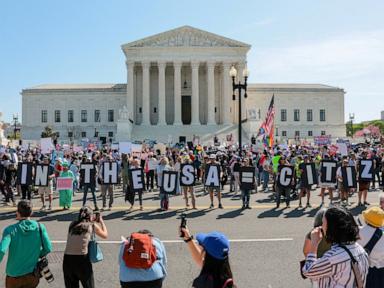
Supreme Court Upholds Birthright Citizenship, Rejects Trump Order
The Supreme Court rejected President Trump's attempt to end birthright citizenship, reaffirming that babies born in the U.S. are citizens.
The Supreme Court on Tuesday rejected President Donald Trump's attempt to end birthright citizenship in the U.S. by executive order, reaffirming more than a century of legal precedent and national tradition that babies born on American soil are automatically American citizens. The 6-3 decision is a significant blow to the president, who had personally lobbied the court to uphold his Day 1 order and even attended oral arguments, making him the first sitting president to do so.
This ruling preserves a fundamental aspect of American identity, rooted in the Fourteenth Amendment. The amendment, ratified in 1868 after the Civil War, was intended to ensure citizenship for formerly enslaved people and their descendants. For over 150 years, this has been understood to grant citizenship to virtually all individuals born within U.S. territory, regardless of their parents' immigration status.
In his majority opinion, Chief Justice John Roberts wrote that citizenship "was the right to have rights -- to freely participate in our political community." He added, "The Framers of the Fourteenth Amendment extended that promise to every free-born person in this land. We keep that promise today."
The decision means that an estimated 255,000 children born annually to non-citizen parents will continue to be recognized as U.S. citizens. Immigrant advocates and civil liberties groups had warned that the president's order would have created immense hardship for these children, potentially leaving some stateless, and would have led to a bureaucratic crisis for millions of Americans whose citizenship is proven by their birth certificates.
Justices Clarence Thomas, Neil Gorsuch, and Samuel Alito dissented. Thomas and Gorsuch argued that neither the Constitution nor federal law guaranteed citizenship to individuals whose parents were not domiciled in the United States. Thomas suggested that the domicile of a child's parents should be the determining factor for citizenship, based on the nation's history and tradition.
President Trump's administration had contended that children born to undocumented immigrants and temporary visitors, such as tourists and foreign students, should not automatically qualify for citizenship under the Fourteenth Amendment's clause. This interpretation challenged the long-standing understanding of the amendment's citizenship clause.
The ACLU, which argued the case before the court, hailed the decision. "A president cannot change the Constitution by executive fiat," said ACLU legal director Cecilia Wang. "Our brave clients and our legal team stand with millions of people around our country who spoke up for one of our most cherished rights. The Constitution's guarantee of birthright citizenship stands strong."
Every lower court that had considered President Trump's executive order had deemed it unlawful and issued orders to block its implementation. The Supreme Court's affirmation of birthright citizenship maintains the status quo and ensures that the legal standing of hundreds of thousands of children born in the U.S. each year remains unchanged.
This article was written by AI based on publicly available news reporting. Original reporting by the linked source.