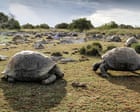
180,000 Giant Tortoises Discovered on Seychelles Island, Outnumbering Humans
A survey revealed 180,000 Aldabra giant tortoises on Seychelles' Aldabra Atoll, marking a significant conservation success.
An unprecedented discovery has revealed approximately 180,000 Aldabra giant tortoises roaming freely on the Seychelles' Aldabra Atoll, far surpassing the human population of the island nation. This marks the highest population figure ever recorded for the species and underscores a remarkable conservation success story.
The Aldabra Atoll is one of only two locations globally where giant tortoises are found in the wild, with a considerably smaller population residing in the Galápagos Islands. The recent survey, a collaboration between the Seychelles Islands Foundation (SIF) and the University of Exeter, provides the first update on the species' numbers since the late 1990s, when an estimated 100,000 tortoises were recorded.
Researchers analyzed five years of tortoise count data collected between 2018 and 2022. The findings, published in the scientific journal Ecology and Evolution, indicate a stable population with a best estimate of nearly 183,000 adult and sub-adult tortoises. This robust population is a testament to decades of dedicated conservation efforts.
Dr. Frauke Fleischer-Dogley, CEO of SIF, expressed her delight, stating that the thriving population is proof of what sustained commitment to conservation can achieve. She highlighted the discovery as wonderful news for Seychelles, the global community, and all those involved in protecting Aldabra's unique ecosystem.
The Aldabra giant tortoise population faced severe decline in the 19th century due to exploitation, with numbers dropping to fewer than 1,000 individuals. However, a comprehensive recovery program was initiated, leading to the establishment of the atoll as a strict nature reserve in 1981 and its designation as a UNESCO World Heritage site in 1982.
Conservationists now consider the recovery of the Aldabra giant tortoise one of the most significant conservation achievements in the Indian Ocean. The long-running monitoring program for Aldabra's giant tortoises is a key factor in understanding and maintaining this success, despite the challenges posed by the atoll's dense vegetation which complicates accurate counting.
The success on Aldabra Atoll provides a powerful case study for conservation initiatives worldwide. It demonstrates the potential for species recovery when long-term strategies are implemented and supported, offering hope for other endangered populations.
Further research will likely focus on the ecological impact of such a large tortoise population and the ongoing management strategies required to ensure their continued well-being and the preservation of the Aldabra Atoll's delicate environment.
This article was written by AI based on publicly available news reporting. Original reporting by the linked source.