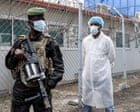
Seven Americans Quarantine in Kenya Ebola Facility Amid US Travel Ban
Seven American aid workers are quarantining in a Kenyan Ebola facility after a US travel ban for those returning from Congo.
Seven American aid workers who had been in the Democratic Republic of the Congo to combat the Ebola outbreak are now quarantining in a newly established isolation facility in Kenya. This development follows the implementation of U.S. travel restrictions that require American citizens returning from Ebola-affected regions to spend three weeks in a third country before entering the United States.
The individuals are the first known people to undergo quarantine at the facility, which has faced significant opposition within Kenya. A court had previously ordered a halt to the facility's construction, a decision that Kenya's health minister announced would be immediately observed. However, construction reportedly continued, according to U.S. officials and satellite imagery.
Franklin Graham, president and CEO of Samaritan's Purse, the U.S. charity employing the aid workers, confirmed their presence at the facility. He stated that all seven staff members are asymptomatic but are being quarantined by the Kenyan government for 21 days. The U.S. government is funding the construction of the 50-bed bio-isolation unit, situated on an air force base in central Kenya, specifically for asymptomatic Americans who may have been exposed to the virus.
The U.S. policy mandates that citizens returning from the Democratic Republic of the Congo, where a significant Ebola outbreak is ongoing, must complete a 21-day quarantine in a third country. This measure aims to prevent the potential spread of the virus into the United States.
Many Kenyans have expressed anger and concern over the facility, viewing it as the U.S. offloading a health risk onto their country. The legal challenge against the facility's construction highlights these public anxieties and the government's struggle to balance international health protocols with domestic concerns.
Despite the court order and public outcry, U.S. officials and satellite imagery indicated that construction of the bio-isolation unit persisted. This suggests a commitment from the U.S. government to ensure the facility's readiness for individuals requiring quarantine.
A U.S. State Department official also confirmed the situation to Reuters, providing further validation of the aid workers' quarantine. The facility's purpose is to house individuals who have been in close proximity to Ebola cases but show no symptoms, thereby mitigating risk during their transit back to the U.S.
This situation raises questions about the international cooperation in managing global health crises, the implementation of travel restrictions, and the balance between national security interests and the concerns of host countries. The ongoing legal battles and public sentiment in Kenya will likely continue to shape the future of such international health collaborations.
This article was written by AI based on publicly available news reporting. Original reporting by the linked source.