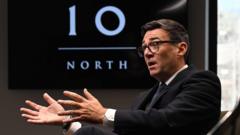
PM Burnham: NHS 'will collapse' without urgent social care reform
Prime Minister Andy Burnham warned the NHS faces collapse if social care isn't reformed, pledging substantial change but offering no timeline.
Prime Minister Andy Burnham has declared the National Health Service "will collapse" if the social care system is not fundamentally reformed, emphasizing the urgent need for action. In his first major interview since taking office, Burnham stated he would not wish to leave his premiership without enacting significant changes to social care, a system he described as "broken."
Burnham's stark warning highlights the interconnectedness of health and social care services. The current social care system, which provides support for individuals to live more independently, is not free at the point of use, unlike the NHS. This often leaves individuals with substantial personal costs for necessary care, leading to a situation where people who could be supported in the community end up requiring hospital admission, placing immense strain on NHS resources.
"The NHS would collapse under the weight of trying to care for people who've really not needed to end up in the NHS system," Burnham told the BBC. While he committed to "put whatever political capital I have into fixing broken social care," he was unable to provide a specific timeline for when these reforms might be implemented, stating he "couldn't put a timeline on it right here, right now."
The Prime Minister is expected to address adult social care in an upcoming speech. However, reports suggest he will not unveil plans for a completely new system at this time. Instead, he is anticipated to announce measures to accelerate the work of the independent Casey Commission, which has been reviewing potential solutions for social care. Baroness Louise Casey's final recommendations are not expected until 2028, but Burnham aims to bring this schedule forward.
Adult social care has long been a complex and persistent challenge for successive governments. Unlike the NHS, which is free at the point of need, social care services in England and Northern Ireland have eligibility criteria based on savings. Those with assets exceeding £23,250 are generally not entitled to council assistance with care costs, a threshold that differs in Wales and Scotland. This punitive system means "quite a lot of people go without care that they need," according to Sarah Woolnough, chief executive of healthcare think tank the King's Fund.
Woolnough indicated that potential reforms could range from making social care free at the point of need to implementing a cap on how much individuals have to spend. She noted that the Prime Minister has "for a long time mooted the idea of a social care system similar to NHS." While such reforms would be expensive, they are described as being "on the scale of what we spend on other public services - around £200bn on the NHS - we are talking for some of these options low billions per year."
Historically, attempts to reform social care have faced significant political hurdles. Burnham himself proposed a universal social care system in England in 2009 as health secretary, which included a compulsory levy to fund it. The Labour government at the time also floated the idea of allowing payments to be deferred until after death, a proposal that drew criticism from the Conservative party who branded it a "death tax."
Further complicating the landscape, Conservative leader Kemi Badenoch has reportedly written to the Prime Minister urging him to rule out tax increases or additional borrowing as methods to finance social care reform. The Prime Minister also alluded to potentially making it more difficult to claim benefits, stating that the country "had to get serious about getting the welfare bill down."
This article was written by AI based on publicly available news reporting. Original reporting by the linked source.