Nearly 300 Ebola Patients Missing in DR Congo Amid Crisis
The whereabouts of almost 300 people who tested positive for Ebola in the DR Congo are unknown, raising fears of widespread transmission.
The whereabouts of nearly 300 people who have tested positive for Ebola in the Democratic Republic of the Congo (DRC) are unknown, according to Africa’s top public health official. Dr. Jean Kaseya, director general of the Africa Centers for Disease Control and Prevention (CDC), expressed concern on Thursday about the missing individuals, highlighting the significant challenges in tracking and containing the outbreak.
The humanitarian crisis in the affected regions, exacerbated by ongoing conflict, means that over 1 million people are living in displacement camps inaccessible to health workers. This lack of access severely hampers efforts to identify, monitor, and treat individuals who may have contracted the virus, increasing the risk of community transmission.
Official figures indicate a total of 1,118 confirmed cases and 291 deaths from Ebola in the DRC to date. Additionally, neighboring Uganda has reported 20 cases and two deaths. The unaccounted-for individuals, whose numbers are derived from patient recovery and death statistics, represent a significant gap in the public health response.
These developments come as World Health Organization (WHO) modeling projects a grim outlook. Projections published in The Lancet Infectious Diseases journal predict approximately 8,210 cases and 1,420 deaths by mid-September. The modeling also suggests a 70% probability of the outbreak spreading to neighboring South Sudan in the coming weeks, underscoring the regional threat.
Concerns about the spread were amplified by a case reported on Wednesday, where a doctor working in the DRC tested positive for Ebola upon returning to France. His employer, the medical NGO Alima, stated they are investigating how the contamination may have occurred. This case highlights the potential for infected individuals to travel across borders, further complicating containment efforts.
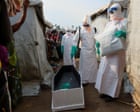
The escalating situation in the DRC is unfolding against a backdrop of severe insecurity and displacement. The presence of over a million people in camps with limited or no access for health personnel creates a fertile ground for the virus to spread undetected. Health workers are reportedly disinfecting coffins in affected areas, a grim indicator of the ongoing challenges.
Experts worry that the missing individuals could be spreading the virus unknowingly within their communities, particularly in areas where awareness of Ebola and preventative measures may be low. The lack of precise data on these individuals makes it difficult for authorities to implement targeted interventions and trace potential contacts effectively.
The international community and health organizations are grappling with how to address the outbreak under such difficult circumstances. The focus remains on reinforcing surveillance, contact tracing, and treatment efforts, while also advocating for improved humanitarian access to all affected populations, including those in displacement camps.
This article was written by AI based on publicly available news reporting. Original reporting by the linked source.