Moscow Refinery Hit by Ukrainian Drones, War Hits Closer to Home
Ukrainian drone attacks struck a Moscow oil refinery and other sites, bringing the war visibly closer to Russia's capital.
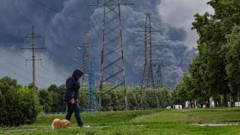
Thick, acrid black smoke billowed over Moscow's skyline on Thursday morning following a Ukrainian drone attack that struck an oil refinery in the city's southeast. The surreal sight marked a stark moment for residents of the Russian capital, where the war in Ukraine has often felt distant.
The attack, described as one of the largest aerial assaults on the Moscow region since Russia's full-scale invasion of Ukraine, also damaged shopping centers and residential buildings. An eight-year-old girl was reportedly killed in a fire caused by one of the drone strikes, according to the governor of the Moscow region.
Despite the significant aerial assault, life in the immediate vicinity of the refinery appeared to continue with a degree of normalcy. An angler was seen fishing by a pond overlooking the smoke, while children played at a nearby playground, and shoppers went about their business. This apparent nonchalance, however, masks a shifting reality for Muscovites.
For a long time, many in the Russian capital seemed to ignore the ongoing conflict in Ukraine. However, recent events, including reports of assassinations of army generals and drone targeting of the capital itself, suggest that the front line is creeping closer, making the war increasingly difficult to disregard.
One local resident, identified only as Slava, who lives opposite the refinery, expressed a sense of not being entirely surprised but still taken aback by the scale of the attack. He described hearing explosions and seeing extensive smoke, likening the scene to something from a movie, visible from his apartment window.
Another resident, Nadezhda, offered a different perspective, finding the current situation far from normal. She drew a comparison to World War Two, stating that despite facing hardships, that conflict was won, implying a perceived lack of urgency or effective response to the current war given Russia's resources.
The attack on the Kapotnya refinery, a significant industrial site, was visible to motorists on the Moscow ring road, underscoring the direct impact on the capital's infrastructure and daily life. The event challenges the perception of Moscow as being insulated from the direct consequences of the war.
This incident raises questions about Russia's air defense capabilities and the psychological impact of such attacks on a population that has, for the most part, lived removed from the direct realities of the conflict. The continued proximity of the war's effects to the heart of Russia signifies a potential escalation in the conflict's reach.
This article was written by AI based on publicly available news reporting. Original reporting by the linked source.