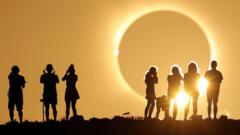
Millions Witness Rare Solar Eclipse Across UK and Europe
Millions across the UK and Europe gazed at a dramatic solar eclipse, the most significant in nearly 30 years, with some experiencing total darkness.
Millions across the United Kingdom and Europe were captivated by a spectacular solar eclipse on August 12, 2026, an astronomical event described as the most dramatic in nearly three decades. While viewers in the UK experienced a significant partial eclipse, reaching over 90% coverage of the Sun, parts of Greenland, Iceland, and Spain were treated to the awe-inspiring spectacle of a total solar eclipse.
This celestial event offered a rare opportunity for people to witness the Moon passing directly between the Sun and Earth, casting a shadow and momentarily obscuring the Sun’s light. The path of totality, where the Sun is completely hidden, began in northern Siberia, arced over the Arctic Ocean, and then swept across Iceland before reaching Spain.
Across the UK, the partial eclipse commenced around 18:00 BST in Scotland and slightly later in southern England. As the Moon gradually covered the Sun, observers noted its progression, with many enjoying clear skies, particularly in central and southern England and Wales. Despite cloud cover in northern regions, crowds gathered at prominent landmarks, demonstrating widespread public interest.
The rarity of the event led to high demand for solar eclipse glasses, with supplies quickly depleted from high-street stores and online retailers. This shortage prompted creative solutions, with improvised viewing devices like colanders and cereal boxes being used to safely observe the partial phenomenon.
The last time the UK witnessed an eclipse of this magnitude was in 1999, making the current event a significant moment for skywatchers. The partial eclipse in the UK saw the Moon obscure up to 95% of the Sun in some areas, such as Cornwall. Meanwhile, in Spain, the alignment was perfect, resulting in total darkness for those in the path of totality.
Astronomy enthusiasts described the experience as a profound reminder of the universe's grandeur. The event generated considerable public engagement, with many sharing their experiences and observations of the celestial display. The eclipse served as a unifying event, drawing people together to witness a shared natural wonder.
While the core event has passed, the memory of this rare astronomical alignment is likely to persist. Such eclipses not only provide moments of public fascination but also underscore the dynamic and predictable nature of celestial mechanics. Future eclipses, though infrequent, continue to inspire curiosity and a deeper appreciation for space science.
The successful viewing of the eclipse, despite challenges like cloud cover and the scarcity of protective eyewear, highlighted the public's enduring fascination with astronomical phenomena. The event's reach across multiple countries also emphasized the global nature of such cosmic occurrences.
This article was written by AI based on publicly available news reporting. Original reporting by the linked source.