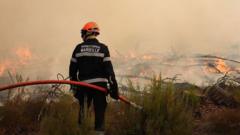
France wildfire: 55,000 evacuated near Bordeaux as fires spread
Tens of thousands evacuated near Bordeaux as firefighters battle a severe wildfire that has destroyed over 150 homes.
Firefighters are engaged in a critical battle to contain a rapidly spreading wildfire near Bordeaux, France, a situation described by officials as "very unfavourable." Overnight into Sunday, approximately 55,000 residents were evacuated from villages in the Gironde region, an area renowned for its vineyards, as the blaze moved erratically towards the city.
This wildfire is part of a larger wave of blazes that have affected Europe in the past week, with France and Spain being particularly hard-hit. The scale of the fires in France's south-west is significant, with 42,000 hectares already burnt, marking it as one of the largest forest fires since World War Two. Since the beginning of the year, nearly 98,000 hectares have been consumed by fires across the country, leading to over 220,000 evacuations in the south-west alone.
Captain Nicolas Braz, involved in the firefighting efforts, noted the fire's unpredictable nature, stating it had generated its own winds, including whirlwinds, making it difficult to manage. In the coastal town of Le Porge, where more than 150 houses have been destroyed among its 3,500 inhabitants, residents have organized an informal support network for the exhausted firefighters, providing meals and rest areas. Volunteer Nathalie Augonnet expressed the community's devastation for their town, forests, wildlife, and those who have lost property, emphasizing the immediate focus on action over dwelling on the loss.
The implications of these fires extend beyond immediate containment efforts. The destruction of homes and natural landscapes raises concerns about long-term environmental impact and the significant challenge of future reconstruction. The erratic behaviour of the fire suggests a need for adaptive strategies in firefighting, potentially influenced by changing climate conditions that exacerbate such events.
Meanwhile, Spain is also grappling with extensive wildfires, forcing the evacuation of over 90,000 people from areas around Madrid and Ávila. Approximately 77,000 hectares have been affected in Spain, with the wildfire in Ávila described as the largest in the country's recent history. The widespread evacuations highlight the severe threat these fires pose to communities and infrastructure across the Iberian Peninsula and beyond.
Residents like Olga Congacha, 50, who fled her village west of Madrid, described the panic and distress associated with sudden evacuations. Returning briefly to her home, she found deserted streets and her house covered in ash, a stark visual of the fire's proximity and impact.
Tourists in Madrid have also witnessed the effects, reporting the sight of fire and smoke near the airport and a noticeable smell of smoke even within the city. This indicates the widespread reach of the fires, affecting not only the immediate evacuation zones but also broader urban and tourist areas.
Questions remain about the long-term management of such large-scale wildfires, their connection to climate patterns, and the effectiveness of current strategies in protecting vulnerable regions like the Gironde, known for its valuable vineyards and natural beauty. The ongoing situation underscores the growing challenge of wildfire management in Europe.
This article was written by AI based on publicly available news reporting. Original reporting by the linked source.