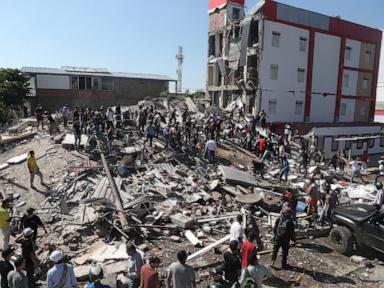
Colombia earthquake kills 132, traps dozens; national disaster declared.
A 7.4-magnitude earthquake struck western Colombia, killing 132, injuring 572, and trapping dozens in collapsed buildings. A national disaster was declared.
A powerful 7.4-magnitude earthquake struck western Colombia on Monday, killing at least 132 people and injuring 572, according to the country's president. The tremor, which also left dozens trapped in collapsed buildings, prompted President Abelardo de la Espriella to declare a national disaster.
The earthquake's epicenter was located 5 kilometers east of San José del Palmar, Colombia, the U.S. Geological Survey reported. The strongest recorded in the country in a decade, it was widely felt across Colombia and in neighboring Venezuela, Ecuador, and Panama.
Destruction has been reported in multiple cities, with some of the hardest-hit regions including Pereira and Cali. In Cali, at least 20 buildings collapsed, and officials confirmed people were trapped in at least one building where a rescue operation was underway for 15 individuals. The city's mayor imposed a curfew to aid rescue efforts and ensure safety.
Broader implications of the disaster are still unfolding, but the scale of damage suggests a significant and long-term recovery effort will be necessary. The U.S. State Department announced a commitment of $15.5 million for the Colombia earthquake response, earmarked for emergency shelter, food, protection, and assessments.
The president stated that 61 buildings had collapsed and over 1,600 homes were damaged or destroyed. Additionally, dozens of health centers, community centers, and roads sustained damage. A hospital in Cali experienced partial collapse of one wing, necessitating the relocation of patients.
In the department of Chuco, the capital city of Quibdo also saw injuries and severe building damage, according to its governor. The earthquake's impact has also disrupted transportation, with seven airports suspending services: Armenia, Cali, Manizales, Pereira, Quibdo, Buenaventura, and Cartago.
While the capital, Bogota, reported no collapsed buildings, the president indicated he was heading to the capital to focus on the emergency. He has convened a unified command post to coordinate response efforts in affected areas, including the Coffee-Growers' Axis region.
The full extent of casualties and damage is still being assessed. The disaster highlights the region's vulnerability to seismic activity and the critical need for robust emergency response and infrastructure resilience.
This article was written by AI based on publicly available news reporting. Original reporting by the linked source.