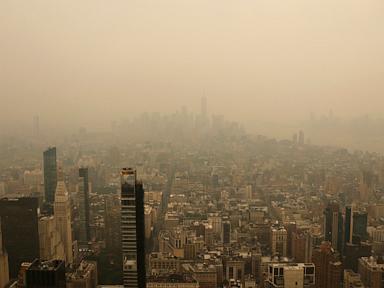
Canadian wildfire smoke chokes New York City; 830+ fires burn
Over 830 Canadian wildfires sent unhealthy smoke into the U.S., blanketing New York City in a hazy orange glow.
Wildfire smoke from Canada descended upon large swaths of the United States, including New York City, on Wednesday, July 15, 2026, blanketing the iconic skyline in a hazy orange glow and prompting air quality advisories.
More than 830 wildfires were actively burning across Canada, with significant blazes concentrated in west-central Ontario, releasing an immense volume of smoke. This smoke, carried by prevailing winds, drifted south into the U.S., impacting air quality for millions across the upper Midwest and Northeast.
By Wednesday afternoon, air quality in New York City and several surrounding regions reached unhealthy levels. New York City Mayor Zohran Mamdani issued a statement urging residents to limit outdoor activities and seek air-conditioned environments, noting the city was distributing free masks to help mitigate exposure. Sensitive groups, including those with heart or lung conditions, older adults, pregnant individuals, and young children, were particularly advised to take precautions.
The influx of smoke is occurring concurrently with an extreme heat spell gripping the Northeast and upper Midwest, with temperatures expected to reach the high 90s and triple digits. Officials issued a statewide Air Quality Health Advisory for New York on Thursday.
The smoke's trajectory indicated it would spread from Buffalo to Philadelphia by sunset on Wednesday, affecting major metropolitan areas and creating hazardous breathing conditions. Cities like Duluth, Minnesota, and Marquette, Michigan, experienced very heavy smoke, while northern Wisconsin faced extreme conditions.
Forecasters anticipate some relief as rain is expected to move into the upper Midwest by Friday and the Northeast on Saturday, which should help to disperse the smoke. However, the poor air quality was projected to persist through Thursday across affected regions.
Images captured from various vantage points, including the Empire State Building observation deck and Hoboken, New Jersey, showed the smoke obscuring familiar landmarks like the One World Trade Center and the Manhattan skyline. Similar scenes were observed in Toronto, Canada, where smoke from the fires also impacted visibility.
The situation highlights the increasing frequency and intensity of wildfire smoke events impacting North America, driven by factors including climate change and prolonged dry conditions. The long-term implications of such events on public health and the environment continue to be a growing concern for officials and residents alike.
This article was written by AI based on publicly available news reporting. Original reporting by the linked source.