Barbados PM Mottley Unveils Slavery Reparations Manifesto, Demands Gender-Based Violence Compensation
Barbados Prime Minister Mia Mottley announced a new reparations manifesto, demanding compensation for slavery's harm, including gender-based violence.
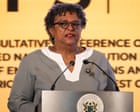
Barbados’s prime minister, Mia Mottley, has unveiled a new manifesto from Caribbean leaders that asserts the “moral, ethical and legal case” for reparations due to the enduring damage caused by centuries of enslavement. The announcement came during a significant conference in Ghana aimed at advancing the pursuit of reparatory justice.
The manifesto represents an update to the Caribbean Community (Caricom) 10-point plan and was distributed by Mottley at the gathering. It introduces contemporary issues, notably highlighting the disproportionate impact of slavery on women and girls, a critical aspect previously less emphasized.
Key to the revised plan is a specific call for compensation related to gender-based violence. The document references data indicating that women constituted roughly 30% of the estimated 20 million Africans forcibly transported across the Atlantic, with at least 1.2 million enslaved women enduring sexual violence. Mottley drew a parallel, stating that compensation for such violence is "no different from the compensation that has been awarded to other nationalities such as the Japanese."
The implications of this updated manifesto are far-reaching, potentially reshaping international discussions on historical injustices and their ongoing consequences. The inclusion of gender-based violence and the linkage to climate justice signal a more comprehensive approach to addressing the multifaceted legacy of slavery.
The draft document, which is still awaiting formal endorsement by Caribbean governments, also asserts that climate justice and slavery reparations are “inextricably linked.” Furthermore, it stresses the necessity of a plan to support Indigenous populations in the Caribbean, who faced genocides upon the arrival of Europeans. This broadens the scope of accountability sought by Caricom.
This initiative follows the United Nations' adoption of a landmark resolution that recognized the trafficking of enslaved Africans as the gravest crime against humanity. The conference in Ghana serves as a pivotal platform for Caribbean nations to collectively strategize and amplify their demands for justice and compensation from former colonial powers.
Caricom is explicitly demanding monetary compensation as part of its reparations agenda. The detailed nature of the updated manifesto, particularly its focus on specific harms like gender-based violence and its connection to contemporary issues like climate change, marks a significant evolution in the ongoing global dialogue on slavery reparations.
While the manifesto is still under consideration by Caribbean governments, its public announcement by Prime Minister Mottley signifies a renewed and unified push for reparatory justice, aiming to address historical wrongs and their lasting socioeconomic and psychological impacts across the region.
This article was written by AI based on publicly available news reporting. Original reporting by the linked source.