Ancient Byzantine City Unearthed in Egypt's Western Desert
Archaeologists discovered a well-preserved fourth-century Byzantine city in Egypt's Dakhla oasis, revealing urban life and economic activities.
Archaeologists in Egypt have uncovered a remarkably well-preserved Byzantine-era city in the country's western desert, offering significant insights into urban development and daily life during that historical period.
The discovery was made in the Dakhla oasis, located within the New Valley Governorate, a region historically significant during Egypt's tenure as part of the Byzantine Empire. The unearthed quarters date back to the fourth century, a time when the Roman Empire had transitioned into its Byzantine phase, and Egypt was a crucial province.
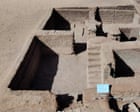
Excavations revealed extensive residential and religious structures, including a prominent basilica-style church that stands at the settlement's head, overlooking its main thoroughfares. The city's layout is characterized by north-south streets intersected by east-west avenues, forming open squares and public spaces. Archaeologists also found numerous artifacts, including coins, pottery fragments, and tools, which shed light on the economic activities of the inhabitants.
This significant find provides a detailed look at the urban planning and economic functions of a Byzantine settlement in Egypt. The presence of a fortified structure with thick defensive walls, alongside houses featuring reception halls and vaulted roofs, suggests a community focused on both trade and security. The discovery of bread ovens, kitchens, and stone grinding tools further illustrates the daily routines and subsistence strategies of the people who lived there.
Mahmoud Massoud, who chairs the archaeological mission, noted the discovery of a heavily fortified structure and many houses with specific architectural features. Hisham el-Leithy, secretary general of the Supreme Council of Antiquities, described the urban layout with its intersecting streets and public squares. The mission also identified the remains of two watchtowers, likely constructed to protect the city's outskirts.
Among the specific structures identified is the house of Tisous, identified as a church deacon, which dates to the second half of the fourth century. The presence of such a structure underscores the religious importance of the settlement and the integration of Christian practices within the Byzantine administrative framework of the time.
The Dakhla oasis itself is recognized for its historical and archaeological potential, currently being on UNESCO's tentative list for World Heritage status. This latest discovery further bolsters its claim for inclusion, highlighting its unique contribution to understanding ancient civilizations and their evolution.
In a separate discovery near Alexandria, 18 ancient tombs were found at Marina el-Alamein. These included rock-cut and limestone tombs, along with pottery and a granite sarcophagus, indicating continued archaeological activity and significant finds across different regions of Egypt.
This article was written by AI based on publicly available news reporting. Original reporting by the linked source.