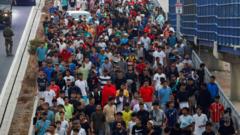
Spain PM Blames Traffickers as 60,000 Migrants Surge into Ceuta
Spain's Prime Minister Pedro Sánchez blamed trafficking gangs after approximately 60,000 migrants crossed into the Spanish enclave of Ceuta from Morocco, with 57 deaths reported.
Spain's Prime Minister Pedro Sánchez has attributed the unprecedented arrival of approximately 60,000 migrants into the Spanish North African enclave of Ceuta to trafficking gangs. The surge, which saw at least 57 people die according to local media, has been described by Sánchez as a violation of Spain's territorial integrity.
Ceuta, situated on the North African coast and separated from mainland Spain by the Strait of Gibraltar, has long been a critical point for migrants attempting to reach Europe. The recent influx occurred after Spain's Supreme Court ruled that migrants intercepted at sea en route to Ceuta or the other Spanish enclave, Melilla, could not be immediately returned to Morocco.
Spanish officials reported that as of Friday evening, over 48,000 people had voluntarily returned to Morocco. One individual speaking to Reuters described the situation as "not good at all," pleading with others not to attempt the journey due to the dangers and fatalities involved. The scale of the arrivals has overwhelmed local resources, with Ceuta's President Juan Jesús Vivas stating the arrivals represented about 70% of the city's population of approximately 83,600.
In response to the crisis, Spain has deployed its armed forces to reinforce security in Ceuta and Melilla. Italy has also reacted by suspending the EU's border-free Schengen arrangements with Spain, highlighting the broader European implications of the situation.
The situation in Ceuta was described by witnesses as chaotic and overwhelming. Carmen Gonzalez Bermudez, who was in the city visiting family, reported seeing "thousands and thousands of people in swimming costumes and all wet, just coming from the sea." While acknowledging that many were "nice people just looking for a better future," she expressed concern about the capacity to accommodate them.
Víctor Ortiz Sotomayor recounted the city being "packed with immigrants, in every square and street, mainly looking for food." He noted that police advised shops to close due to the overwhelming numbers, and he and his family were staying home out of fear. Comparing the current event to a previous surge in 2021, he expressed concern that security forces appeared less active than before.
Spain's Interior Ministry provided a slightly lower estimate of arrivals, citing 50,000 people since Thursday morning. The sister city of Melilla also experienced a significant, though smaller, influx, with between 300 to 400 migrants attempting to cross.
The diplomatic relationship between Spain and Morocco, who both covet Ceuta and Melilla, has historically been strained over these enclaves, which constitute the European Union's only land borders with Africa. The timing of this mass crossing during the summer months, a period often marked by increased migration attempts, adds to the complexity of the situation.
This article was written by AI based on publicly available news reporting. Original reporting by the linked source.