Indonesia Earthquake: 51 Dead, Thousands Displaced as Rescue Efforts Intensify
A 7.7 magnitude earthquake struck Flores, Indonesia, killing 51 and displacing thousands, with rescue operations ongoing.
A powerful magnitude 7.7 earthquake struck the Indonesian island of Flores early Saturday morning, leaving at least 51 people dead and displacing approximately 5,000 residents. Rescue efforts are currently underway as authorities work to find survivors amidst the widespread destruction.
The shallow quake, which occurred just 15 kilometers below the surface, hit shortly before 05:00 local time on Saturday (22:00 GMT on Friday). This event marks the deadliest seismic incident in the Southeast Asian nation since 2022, when hundreds perished in West Java. The region is known as the "ring of fire" due to its high seismic activity, a fact underscored by a subsequent magnitude 6.9 earthquake elsewhere in Indonesia.
Preliminary reports from the National Disaster Management Agency (BNPB) indicate severe damage to over 900 homes and hundreds of other buildings. The tremor was accompanied by 341 aftershocks. Manggarai province was among the hardest hit, recording 24 fatalities, while East Manggarai saw 17 deaths. Sikka province reported three fatalities and the displacement of 3,356 people, with an additional 2,078 evacuated from Manggarai.
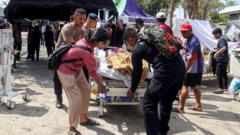
The full extent of the disaster is still being assessed due to the remote and mountainous terrain of the affected areas. Beyond residential buildings, dozens of schools, healthcare facilities, and government offices have also sustained severe damage. Ruteng Regional Hospital in Manggarai is among the affected institutions, with its operating theatre and clinic ceilings collapsing, forcing patients to be treated in tents.
Deputy Health Minister Benjamin Paulus Octavianus stated that 36 people were seriously injured and 77 suffered minor injuries in the East Nusa Tenggara province. "It will take time to assess the full extent of the destruction," officials noted, highlighting the challenges posed by the geography. The BNPB has identified meeting the basic needs and providing logistics for evacuees as top priorities, dispatching tonnes of emergency supplies.
Images from the port in Maumere, Flores' largest town, showed significant damage to the terminal building, with large concrete chunks falling and a gangway collapsing, sending passengers into the sea. Governor of East Nusa Tenggara province, Emanuel Melkiades Laka Lena, reported that some victims were killed in their sleep by falling debris.
Residents described being jolted awake by the tremor. Arnold Welianto, from a coastal village in Sikka, East Nusa Tenggara, recounted being startled from sleep and immediately checking on his child. Many residents, fearing further tremors or aftershocks, had already fled to higher ground in the hills.
The immediate focus remains on search and rescue operations and providing essential aid to those displaced. The ongoing efforts are complicated by the extensive damage to infrastructure and the challenging terrain, underscoring the significant task ahead for recovery and rebuilding in the affected provinces.
This article was written by AI based on publicly available news reporting. Original reporting by the linked source.